
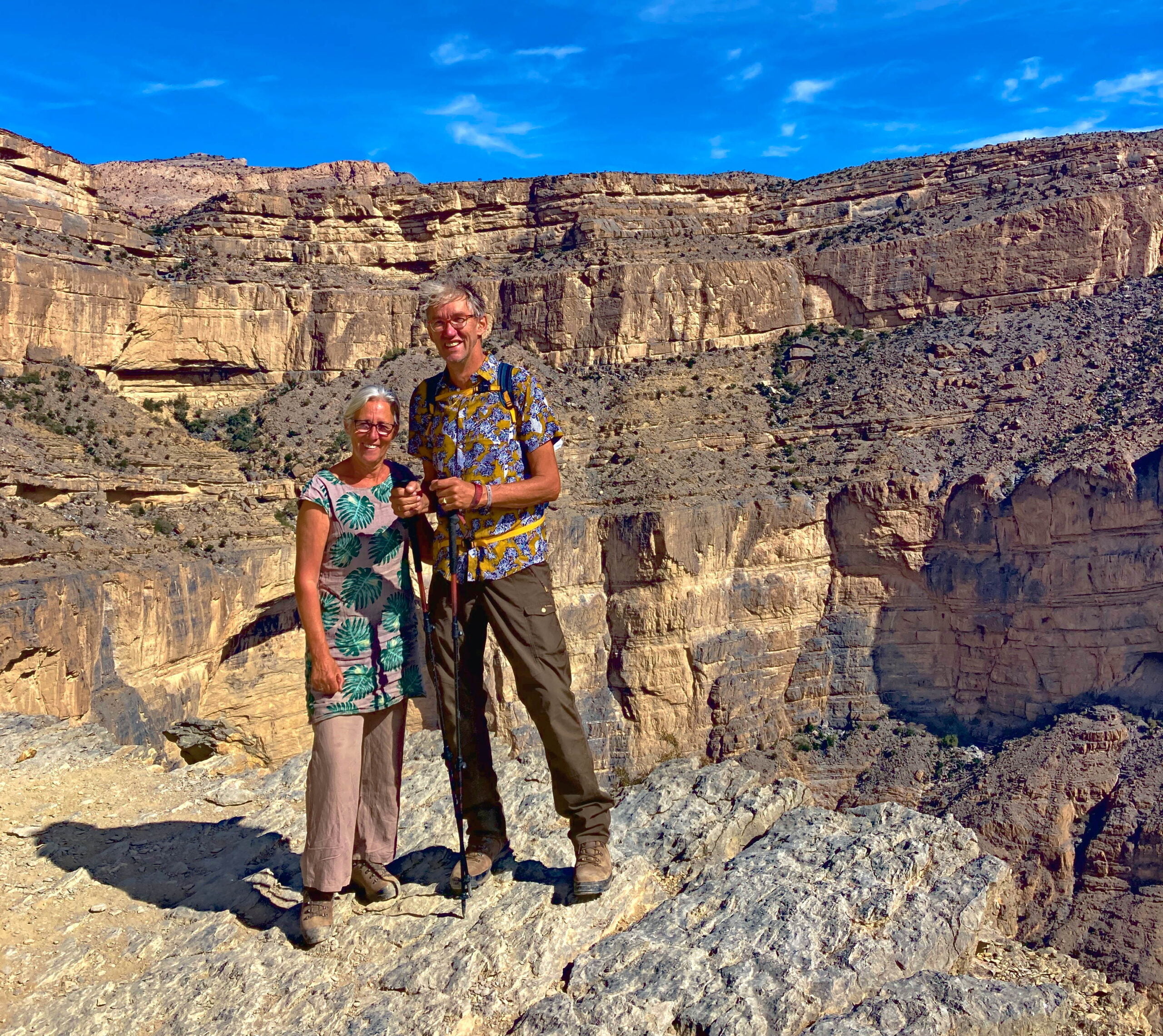
We spend our first three weeks in Oman in the mountainous north of this southern Middle Eastern country. Here we get a first impression of this rich country, not only because of the oil, but also because of its rich history.
But, we start our time in Oman with a stay on the beach of Sohar, in peace and quiet, recovering from all the emotions of the recent trips through Saudi Arabia and the United Arab Emirates.
Our travels in Oman.
For a more detailed day by day report on our trip through Oman, see Sonja’s Polarsteps.
The beach of Sohar
All the emotions of the past few weeks are still with us. The trip through Saudi Arabia, with the endless hospitality, the Dakar Rally 2024 and the problems with Milady’s engine, left us with many impressions. Our stay in the Emirates, where we were able to arrange a new motorcycle for Milady, is also still fresh in our memories.
We therefore decide to rest for a few days on the beach of Sohar. We read a lot, do our laundry, swim in the sea, update our blogs and videos, catch up with passers-by and enjoy the nice weather and the peace and quiet on the beach.


The Al Hajar mountains

From Sohar we drive into the mountains, wonderful to be able to look up again at the mountain peaks of the Al Hajar mountains. After the deserts of Saudi Arabia and the Emirates, this mountain range is a breath of fresh air. Yet the mountains are also very different from the mountain ranges we have seen before. Here too it is very dry with every now and then a bush of green, just like in the deserts.
As we go higher into the mountains the temperatures become a bit milder, it was also quite warm at the beach of Sohar, despite the winter season.
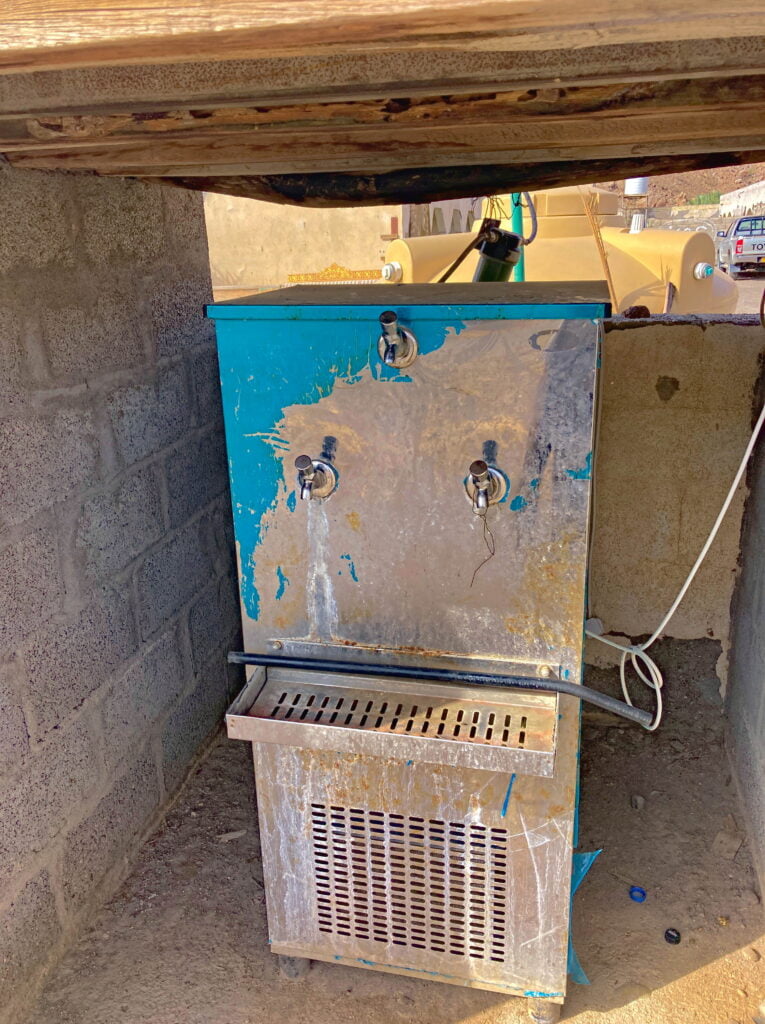
By the way, water is also readily available here, just like in Saudi and the Emirates. We often find these types of public drinking water facilities where we can refill filtered and cooled water.

The Al Gharbi or Al Hadjar mountains
Al Wahrah
We travel further southeast, into the Al Gharbi mountains. Here we stop at the Al Kuhtm Tower in Al Wahrah. When we want to drive away, we are invited to the family who live next to the tower. They offer us coffee and dates, as we have been offered so many times in the Middle East. In the end we also have an extensive lunch, I play with the children and we have nice conversations with the family.


Al Banah
Later, on the same day, we will stop at the archaeological site of Al Banah.

There Ahmed asks us to come and drink kahwa (coffee) at his house, a custom we know well by now 😉. Unfortunately, Ahmed does not speak English, but luckily his sister Tahani does. Great conversations follow and we are even invited for dinner. But first Ahmed shows us their farm and takes us along the village’s Falaj. Through this irrigation system, all plantations of all families here are supplied with water one by one. The water originates in a system of natural hot springs that are also used by the village as a shower/bath.


For dinner, the family has prepared a tuna dish especially for us, as Sonja does not eat meat.


We can spend the night in the parking lot at the house and the next morning we say goodbye to the family, not after we have eaten a traditional breakfast with Ahmed and received all kinds of presents.


Al Ayn “beehive” tombs
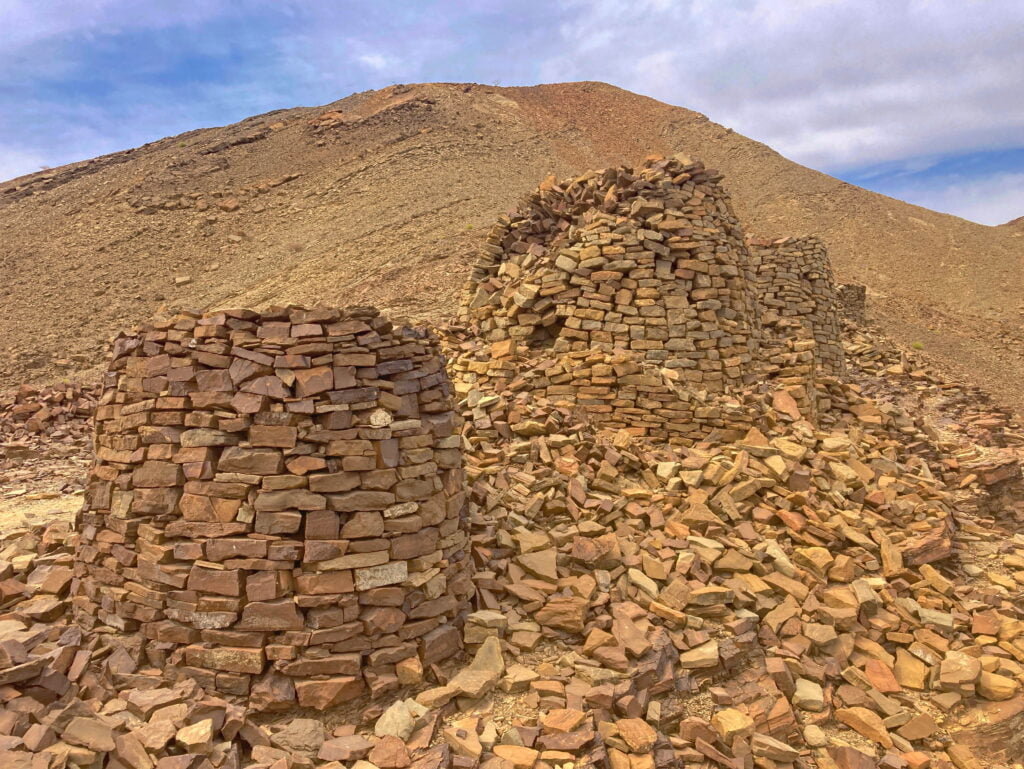
Also in Oman, beehive-shaped graves can be found in Al Ayn, as well as in Al Ain in the Emirates. These tombs date from the Hafit period (c. 3100-2700 BCE), the earliest period in Oman’s Bronze Age (c. 3100-1250 BCE). The graves are beehive-like cairns in which up to 30 people could be buried. Since 1988, this site has been a UNESCO World Heritage Site.



Jebel Shams and the wadis
As we go deeper into the Hadjar Mountains, the mountain peaks become higher and the valleys deeper. The clouds that have been blocking the bright sun for several days are thickening and we are being warned that rain is coming. During times of rain it is dangerous to enter the wadis because these dry riverbeds can suddenly fill up. Nothing is happening yet, but we are alert.
Wadi Damm
We drive and walk into Wadi Damm with the warnings in mind. It is warm today and there are few clouds. The weather forecast predicts rain in 3 days.


Jebel Shams
We find a dirt road that is shorter than Google Maps predicted (25 km instead of 130 km). We take it towards Jebel Shams, the highest peak of the Hadjar mountains. Despite the wind, the rain still seems far away on this mountain top.


We find a beautiful spot at the top with a view over the mountains and a beautiful sunset and sunrise.


We go to sleep with a sigh, “how good we are!”
The Balcony Walk
The next morning we get up early, we want to do the Balcony Walk today. The path runs for about 5 kilometers along the edge of the Wadi Ghul valley, the height difference between the path and the valley is about 1,000 meters.


We find this quite a tough walk and after completing the tour we treat ourselves to coffee and tea with a croissant in the coffee shop at the top. We stay another night at the sunset viewpoint (coordinates: 23.2048325, 57.1964761)
Wadi Ghul

We were able to see Wadi Ghul from above when we did the Balcony Walk. The green palm oases and the flowing water are waiting to be discovered by us. We enjoy the trip and our Milady Landy is back in her element on the unpaved river bottom of the wadi.
The picturesque Misfat Al Abriyeen
The village of Misfat Al Abriyeen is located in an oasis of palm and other fruit trees. This plantation is also supplied with water with an ingenious falaj that ensures that all fields receive sufficient water.


The fort of Bahla and the Jabreen Castle
Bahla Fort and Jabreen Castle are two “must see’s” in this region of Oman.
The medieval fortress of Bahla has been expertly restored. Hamed, who receives us at the entrance of the fort, tells a lot about the fort and its history.


On Sonja’s Polarsteps you can read an extensive report about our visit to the fort.
Later we also visit the Jabreen Castle, which is even more impressive because of the beautifully furnished and decorated rooms. Imam Bil-Arab Bin Sultan, the builder of this castle ruled the area and developed the castle as an important learning center for astrology, medicine and Islamic law.


Nizwa and surroundings
The city of Nizwa is one of the tourist attractions of Oman. With its medieval castle, goat market and the nearby Oman Across Ages Museum, the city has a lot to offer. We decided to book a hotel, especially in connection with the weather forecast, in the center, with a view of the Nizwa fortress, hotel Durrat Nizwa.

Flooding in Nizwa
As we enter the city we see that the large parking lot in the center is full of cars. We have been warned not to park our car here, this is the bed of the wadi!
The next morning, it has rained all night, we drive out of the city center again and we have decided to stand at the Nizwa Bikers Camp. This is a farm near the city (half an hour’s walk) whose owner makes his grounds available free of charge to overlanders and other campers (coordinates: 22.9155861,57.5282469). We still have to drive through the wadi:
It also rains quite a bit at the campsite at night and the next morning the entire wadi in the center of Nizwa appears to have been flooded to nearly 2 meters above the parking.
We had not realized that the rising water, which mainly flows through the city from the surrounding mountains, could have these kinds of consequences. Later we hear that two French tourists were surprised by the water in a nearby wadi and died.
Oman Across Ages Museum
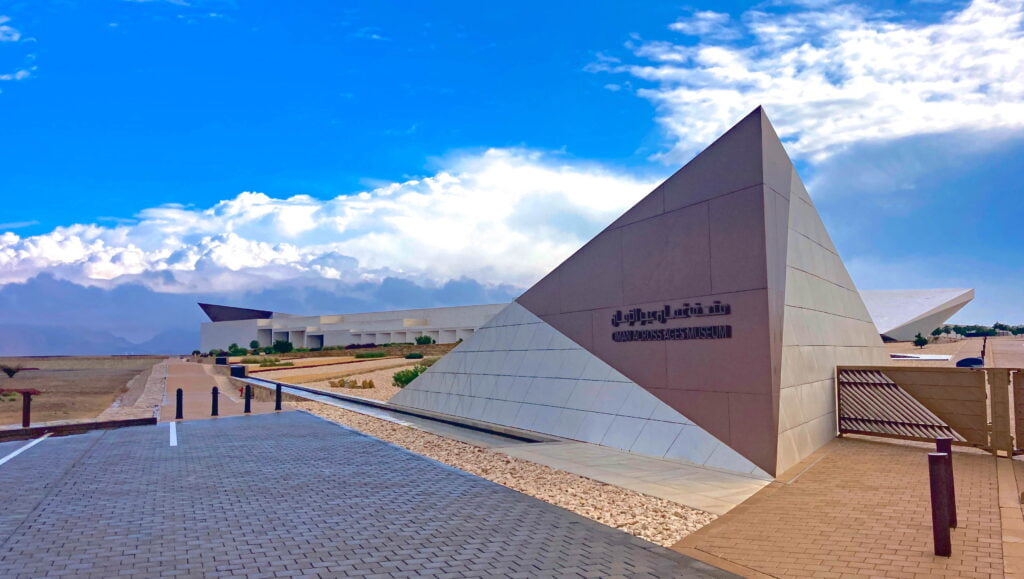
If you are near Nizwa then this museum is a must. The building itself is a marvel of architecture and the exhibition in the museum is a top achievement by any standards. The interactive screens and projections, the beautifully arranged museum exhibits and the well-thought-out decor, they all contribute to a beautiful representation of the many millennia of history of the country of Oman.


Al-Bashayer Annual Festival for Arabian Camel Racing
We experience a day with some of the preliminary rounds, this video says it all:
The goat market on Friday
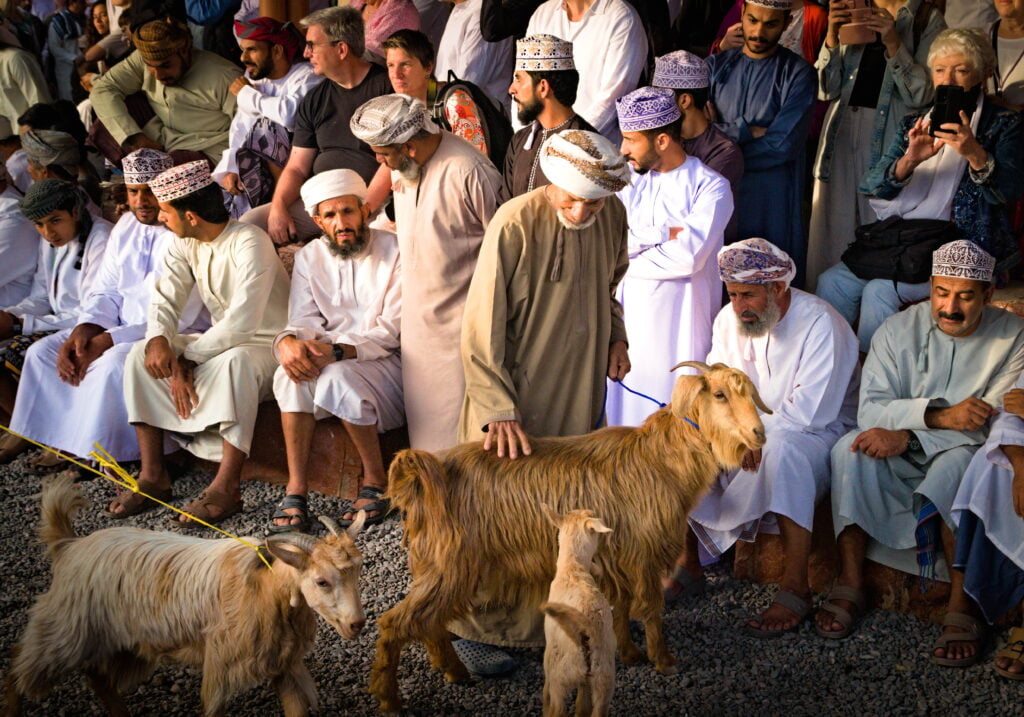
An experience that is recommended on several forums is the Friday goat market in Nizwa. The fact that the market is well promoted is clearly visible from the large number of tourists who arrive early in the morning.
Because it is early, we are at the market at 6 am and there is already activity. Palm flowers are sold, the male ones, which are necessary for the pollination of the date palms.


Like any market, this market is primarily about the merchandise, the goats, but the people walking around are just as interesting to us.




The wadis and mountains around Nizwa
On Sonja’s Polarsteps you can read an extensive report about our adventures in the wadis and mountains.
This video gives a visual impression of our experiences.